

Description
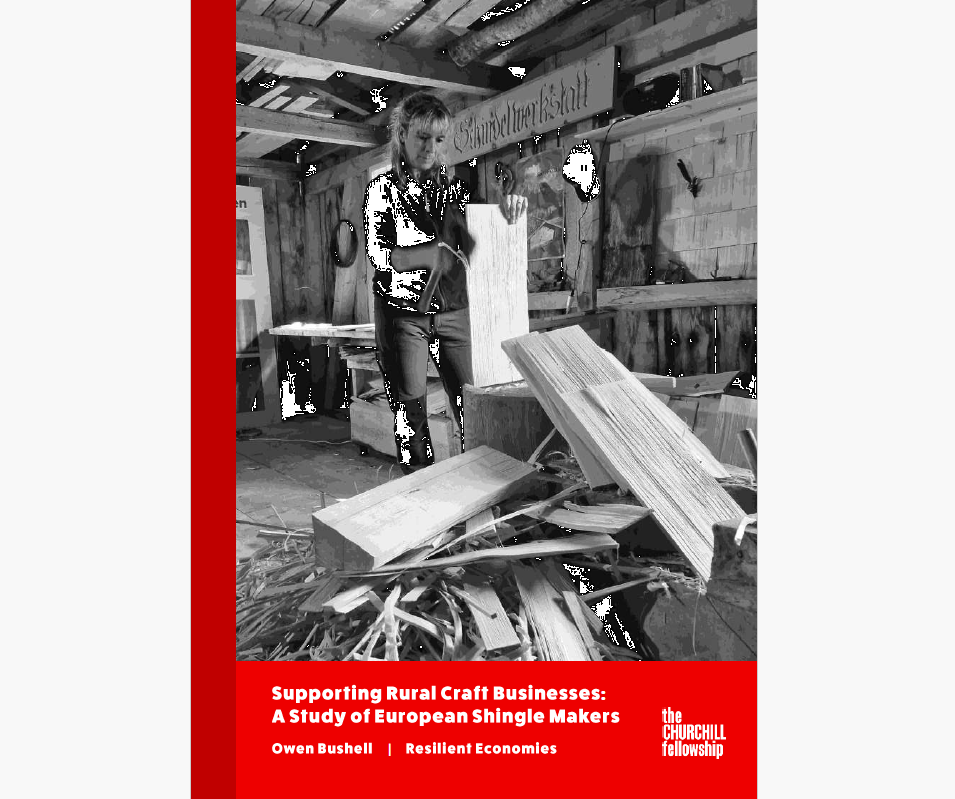
Reforesting Scotland have printed a short run of these reports, written by Owen Bushell as part of a study tour across Europe. We felt that there is a strong synergy between this study and our aims to restore local scale forest industries across Scotland, and this was echoed by the response to Owen’s talk at this years annual gathering. The report is priced to cover the printing costs. Please contact Owen Bushell directly for more information.
The report is 72 pages and printed in full colour in A4 magazine format. Price includes postage.
The following is the introduction taken from the report:
Rural Optimism: A Manifesto
At the very beginning of my travels for this report, Linda Lindblad of the Swedish Hantverkslaboratoriet exclaimed to me: “Ah! You are a rural optimist!” Rural optimism is a fantastic phrase to describe the philosophy of using rural craft to create resilient economies. The economy of the rural optimists can take root in the production of societally useful things which in themselves are rooted in natural materials and need not be a burden on ecology, indeed very often they can be very beneficial to it. It can inspire a shift change away from the disposable and enforce appreciation of things which require time and skill. Being around and possessing skill brings great meaning and contentment in life.
A resilient network of cottage industries creates and sustains a supply chain which keeps and brings money in local circulation. It would be in our cultural memory to think of cottage industries as archaic, the industrialists will be quick to say they are inefficient. Yet as a model it can be immensely productive. Our monolithic modern industrial systems strip away the human touch, and with it, connection and meaning. A cottage industry model can be very reactive to local needs and in conversation with a local community, in a way in which a large corporation cannot.
This mode can also circumvent the boom-and-bust storms that may come in intangible global financial markets. The deep root that these crafts have in unwavering natural materials couldn’t be further away from crypto currencies or stock market derivatives. They are inherently peaceful. Craftsfolk don’t start wars overseas. It does not take a great stretch of the imagination to see that with a comparatively small amount of good structure and support, meaningful work in rural crafts can be found for a great many, especially young folk, in a way which can be so much more fulfilling and more conducive to living healthy, happy lives – where the sum is greater than that of the parts. Inside of such a model surely lies a means to reduce many burdens on the health service.
The importance of sustaining the skills which come from traditional crafts is immensely important. This is not a glorified, whimsical or romantic lifestyle. In such skill lies a whole technology system which is highly sustainable (genuinely so, not in greenwash terms), is local in nature, has a low or even negative carbon footprint and is very harmonious if not beneficial to nature. Traditional craft businesses related to architecture and the building trades underpin the maintenance and repair of all the historic buildings we have in the UK. Without them, there would be no castles, stately homes, cathedrals, windmills or Tudor timber frames.
Such crafts make us appreciate what we consume. We are consistently divorced from the making of things and so craft provides a means for reconnection. Increased appreciation encourages us to take only what we really need. They gift and create beauty in our lives and the built environment. This sentiment is best summarised by the words of William Morris, “Have nothing in your house that you do not know to be useful, or believe to be beautiful.”
In a time of climate crisis, biodiversity loss and the age of oil, the old ways hold so many solutions for the problems of our time, but they need a distinct sensitivity and broad, multi-faceted understanding to cultivate their continuation. They seldom satisfy the cost-benefit-analysis measure or the structure required of conventional business plans. If an emerging craft business takes a business loan in the conventional way, it can be disastrous.
This is why to make a living from traditional crafts and keep the spirit of these ways alive is always an uphill struggle. There are huge barriers facing someone wishing to start making a living in this way, to stay in practice, and to know what to do when it’s time to pass it on. It is in this myriad of factors I hope to find the successes and make some suggestions for a better way forward.

