

Reforesting Scotland is a network supporting reforestation in the widest possible sense. Our members are foresters, crofters and ecologists, but also artists, architects, foragers, furniture makers – and lovers of trees and woods in any other occupation. Together we are putting back Scotland’s forest cover and its forest culture.
When we lost our forests (down to 5% cover by the end of the 19th century), we also lost the traditions that went with those forests, such as foraging, hutting, and building with wood. Many of the plants and animals that filled those ancient woods were also lost or severely diminished. Reforesting Scotland is about putting back all these missing pieces, not just the trees.
Over the years we have produced a range of projects, publications and policy statements, but what we do, individually and collectively, also goes beyond formal projects, and covers a wide range of themes, some of which are illustrated in the ‘What we do‘ section. Our activities are inspired by the Reforesting Scotland vision.
The annual Reforesting Scotland Gathering provides the opportunity for members to meet and share ideas and experiences in an informal and sociable atmosphere. Members also have various online forums through which to communicate throughout the year.
As a grassroots charity we are looking for new members who can help us take up the challenges that face Scotland’s native forests and woodland culture in the future. Whatever your interest, be it as a tree grower, a craft worker, a designer of buildings, or simply as a supporter of Reforesting Scotland’s aims, join Reforesting Scotland and help practical work towards the regeneration of Scotland’s land and communities.
Members
Reforesting Scotland is its members, and one of the most important things it does is to give them opportunities to communicate and collaborate with each other.
Meeting other members
The best opportunity to meet RS members is at the Annual Gathering.
The Radical Rowan newsletter
The Radical Rowan is a newsletter by and for RS members, keeping each other up to date with RS projects and RS-related projects we’re involved with. Email rowan@reforestingscotland.org if you have material to offer for the next issue or if you can help with collating, editing or layout.
A say in our running
The AGM – held each year during the Annual Gathering – gives Reforesting Scotland members an annual opportunity to review how the organisation is running and what it is doing. It is at the AGM that the charity’s directors are appointed for the coming year. If you are an RS member and would like to serve as a director, get in touch before the Annual Gathering.
Other ways of being involved
Depending on your time, energy, talents and inclination, there are many ways to help Reforesting Scotland! You could arrange for the RS display – or the Forest Garden display – to be on show at a local venue or event. You could simply distribute a few RS leaflets, or help to distribute the Journal. If you’re a public speaker, there’s a Reforesting Scotland powerpoint slideshow which you could use to tell people about RS.
Everything Reforesting Scotland is and does happens because its members make it happen. If you think something is missing from current activities, maybe you’re just the right person to add it to the mix.
Directors
Reforesting Scotland (RS) is all of its members, but work done and decisions made are often down to a much smaller group of people, the directors, staff and core volunteers.
Amanda Calvert describes herself as ‘thriving on work’, which is just as well given her CV. She started as a biology teacher but quickly moved out of teaching and into building dry stone walls and gaining a Masters in forest ecology. She has had a varied forestry-related career, from auditing wood fuel quality assurance schemes and checking nursery bio-security to researching markets and management systems for small woods. She has also been a director of the Community Woodlands Association.

Phil Knott is a crofter on the Isle of Skye who has had a life-long passion for trees. Along with his partner Laura, they have a 3 ha wooded croft in the Sleat Peninsula, planted around 16 years ago with a mix of native species. Keen to manage the space for wildlife as well as food, fuel and fibre production, they have been slowly diversifying their croft with a great range of fruit trees and shrubs, using the shelter that their young trees afford. Phil is a naturalist at heart, and knows the wildlife of the Highlands and Islands intimately. With his background in crofting, land management and biodiversity, Phil also sits as the vice chair of the Scottish steering group of the Nature Friendly Farming Network, as well as on the Agriculture and Environment Committee for the Scottish Crofting Federation and the Cross Party Group on Crofting. He is passionate about integrating trees across the landscape, especially where there are multiple benefits for horticulture and livestock. Phil can be found on Twitter and the croft can be found on Facebook and Instagram as Wildlife Croft Skye.
Iain Matthews is a lecturer in Ecology at the University of St Andrews. His main teaching and research interests are the ecology of anthropologically impacted habitats and their ecological restoration. He has been a member of RS for 15 years, and lives just outside of St Andrews with Lynne and their two sons, Rowan and Struan and 11 acres of mixed deciduous woodland.
Angie Newton is a retired biologist specialising in mosses and liverworts. She is now restoring an area of woodland, parts of which she is bringing into coppice rotation.
Mia Lalanne lives in north Argyll. Her day job is project coordinator with charities including Scottish Rural Action and the Argyll Countryside Trust, where she supports the intergenerational rural movement and other community-led initiatives. When not stuck behind a computer, Mia is an active member of her local skiff rowing club and also enjoys needle felting (which she first discovered at a Reforesting Scotland gathering!)
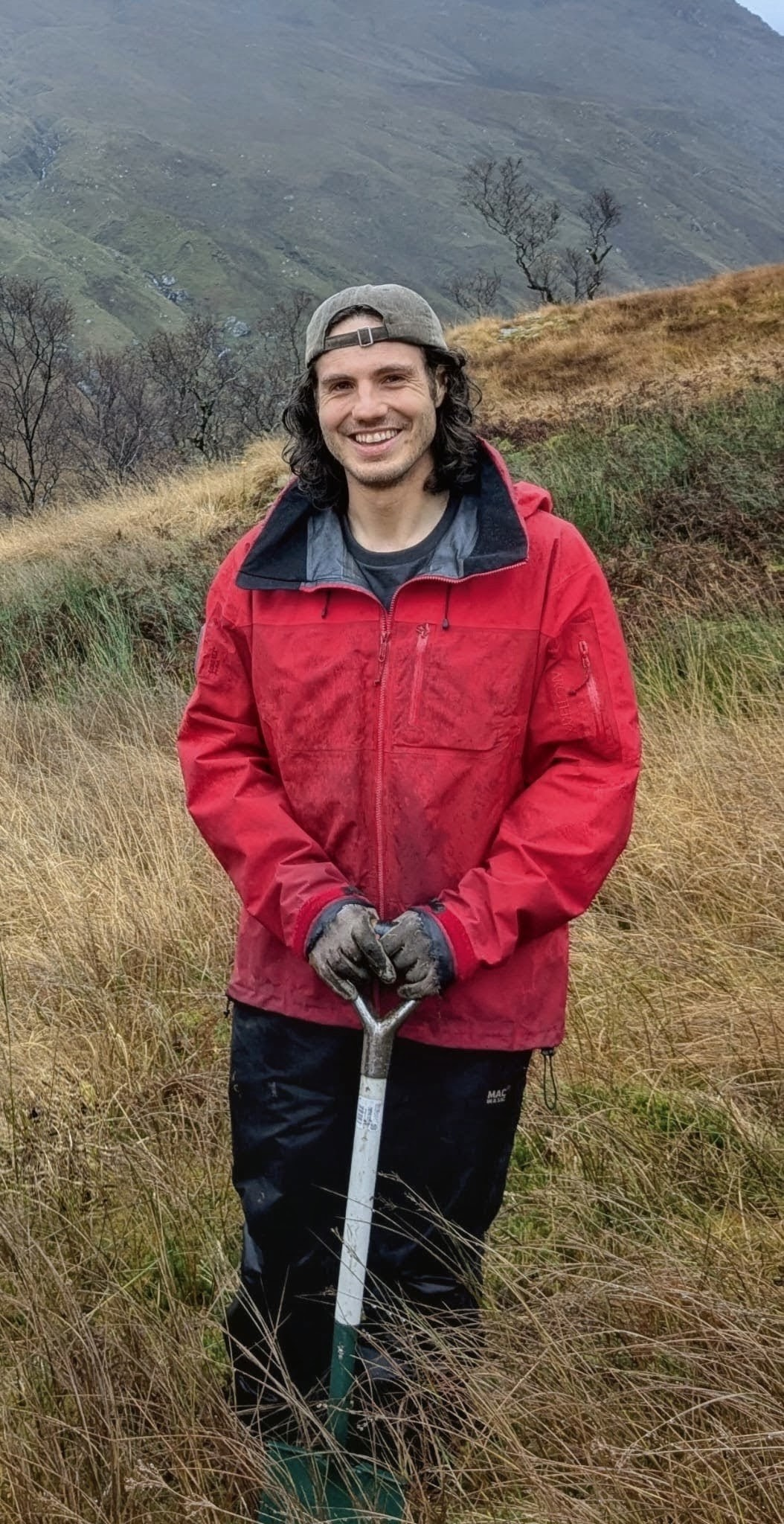
Elaine McKinney is Geography graduate from Edinburgh University and spent most of her working life in global multinationals in compliance, privacy and information security roles. However, Elaine has recently planted her 5 acre field with 18 hundred trees (with the help of her children and their friends) and has a passion for this project to add to the re-establishment of native tree species in this small corner of the Scottish Borders. Elaine is planning to convert two horse shelters on her land into huts for family use and to seek planning permission for a tiny house.
Tim Starck moved to Scotland five years ago to be closer to the Highlands and started out as a seasonal ranger with the National Trust for Scotland at Ben Lawers. It was a crash course in Scottish land management and rare alpine flora found in this area, and it set the direction for everything since. He went on to set up Glenfalloch Specialist Plant Nursery at the north end of Loch Lomond, where he now works full time alongside volunteers from Loch Lomond and The Trossachs National Park, looking after every stage from seed collection through to planting out.Their aim is to secure local provenance tree supply for woodland creation schemes across the National Park by producing high-quality native trees at scale.
Tim is passionate about seeing woodlands return to the Highlands for the benefit of wildlife, and about connecting people to those woodlands by increasing the value of our native timber. He has a special interest in temperate oakwoods, Caledonian pinewoods and montane scrub, the habitats he’d most like to see restored and expanded.
Staff and consultants
Much of Reforesting Scotland’s activities are carried out by the directors and other volunteers, but there are also a few part-time staff and freelancers working on specific aspects.
Alan Carter is our Co-ordinator, dealing with most of Reforesting Scotland’s day-to-day admin – heartwood@reforestingscotland.org
Sonja Brodie edits the Reforesting Scotland Journal – journal@reforestingscotland.org
Al Whitworth and Alan Carter manage this website, which is updated by a team of RS members and staff – web@reforestingscotland.org
Other Funders & Supporters
Reforesting Scotland is reliant on the generosity of individuals, companies and other organisations in order to help us achieve our aims. Over the years we have been very successful in attracting funding support to allow us to work on a variety of projects. However, funding – especially core funding – is always a challenge for a small organisation like Reforesting Scotland.